From Concept to Bits: The F5 Hierarchy
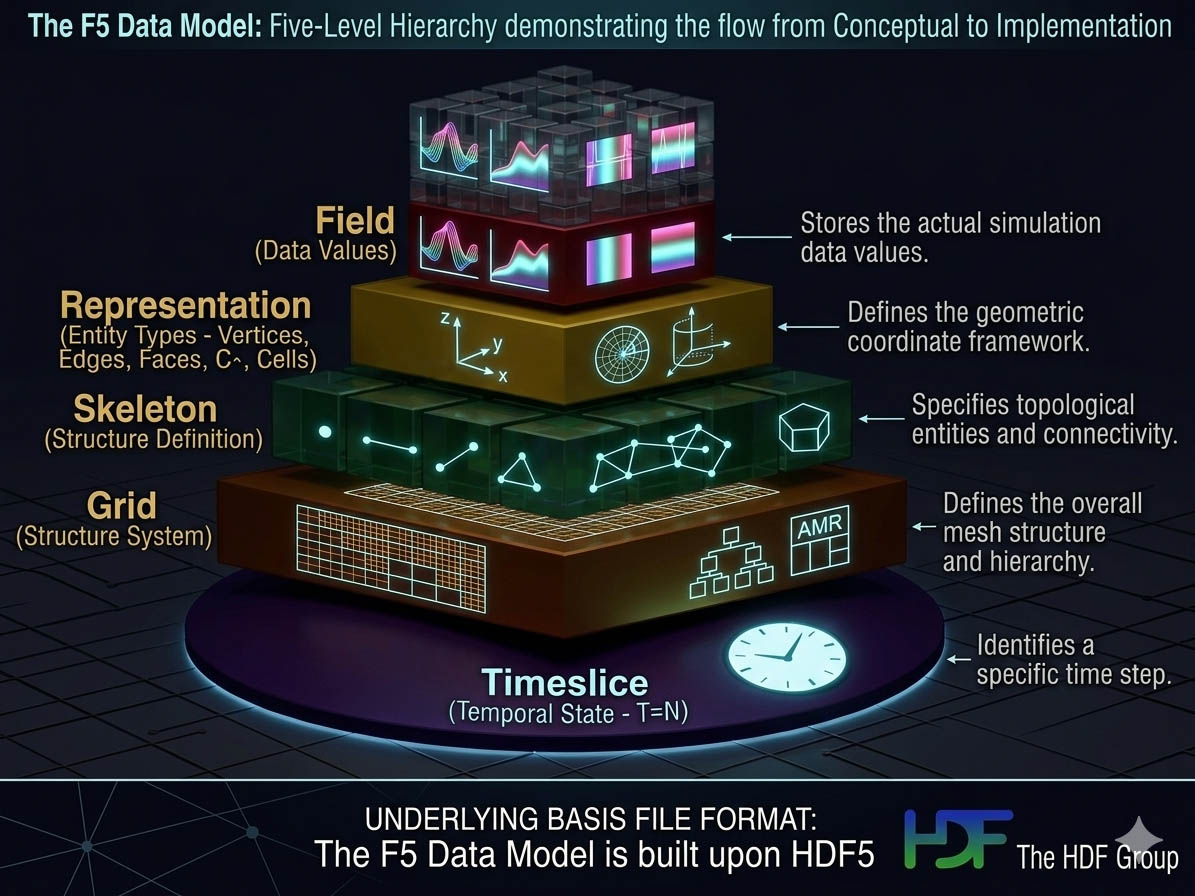
F5 organizes data into five logical layers. Semantic information is fundamentally placed into the structure, not into enumerated lists or keywords.
Mathematically rigorous. Forward-compatible. AI-ready.
"Without a data model, data are just numbers, or, even worse, bits."
- Cook & Matarazzo (2009)
"The proper abstractions for scientific data are known. We just have to use them."
- D. Butler & M.H. Pendley (1989)
90% of visualization time is spent reading data, not visualizing it. F5 is the codec agreement that turns HDF5 into a meaningful scientific structure.
F5 organizes data into five logical layers. Semantic information is fundamentally placed into the structure, not into enumerated lists or keywords.
A triangular surface in F5 is just two datasets and two logical paths:
This simplicity scales. Simple cases are stored simple. Complex cases - including AMR and tensor fields - build from this foundation via forward-compatible mathematical building blocks.
Download Sample: TriangularMesh.f5
/T=0/MySurface/Points/StandardCartesianChart3D/Positions
/T=0/MySurface/Triangles/Points/Positions
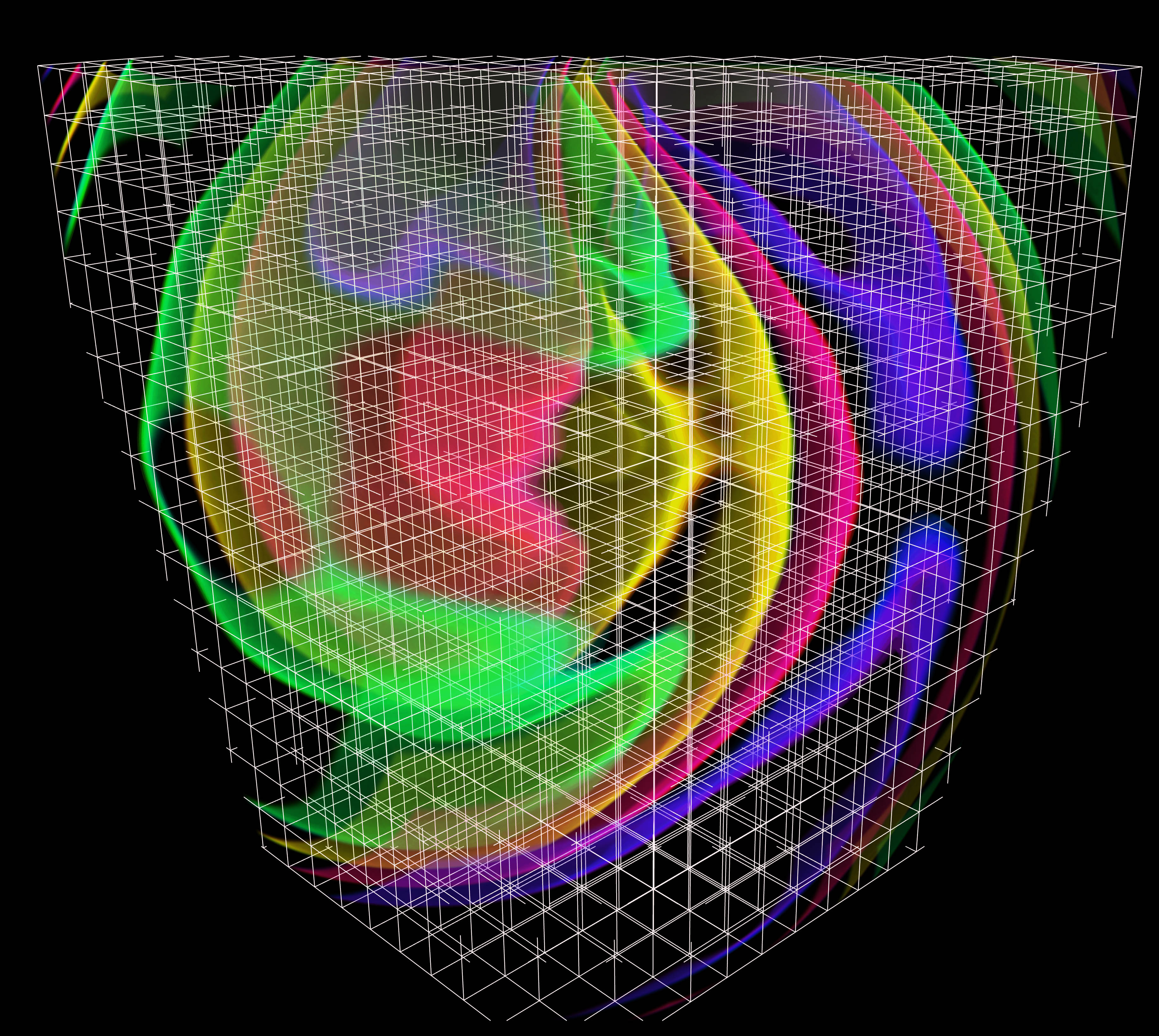
F5 handles CFL-governed multi-rate time stepping and cross-timeslice references natively.
Whether it's a simple mesh or complex gravitational wave simulation, the model treats them with the same mathematical rigour.
E ≈ B × F
Base space x Fiber space. The same mathematical framework that describes general relativity describes your simulation data.
View Classification Matrix Explore Model